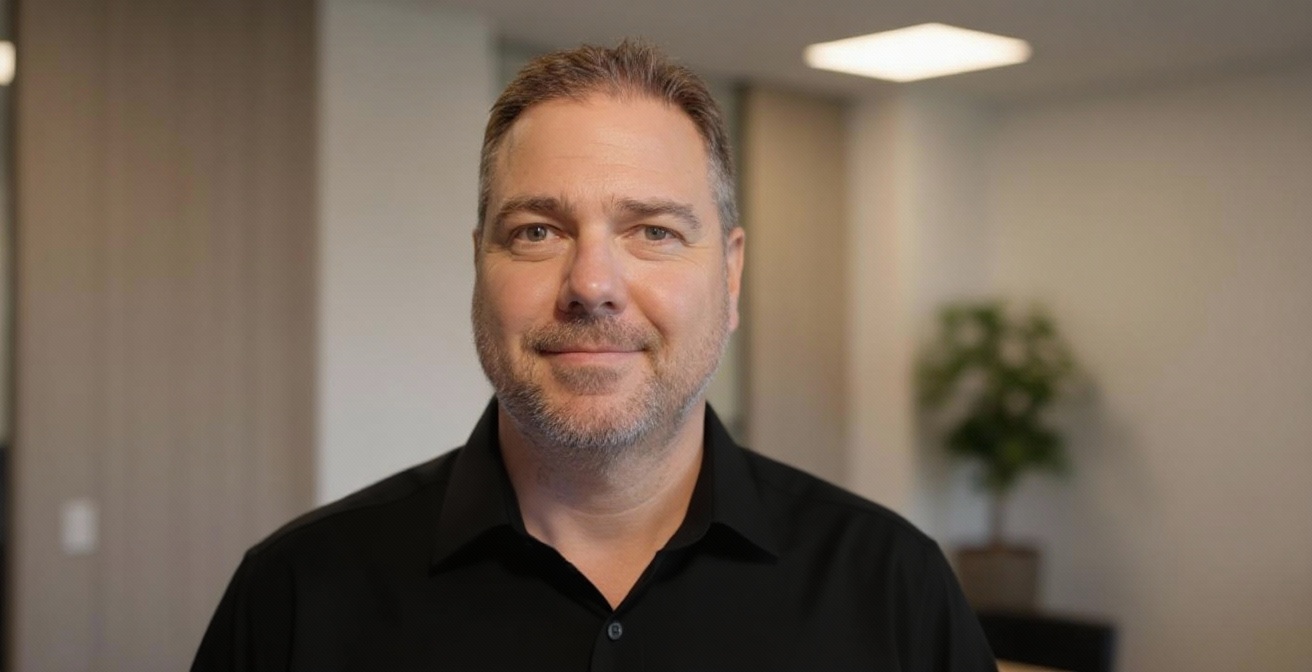
I grew up expecting to work with my hands. Ontario, practical upbringing, the kind of childhood where you learned to fix things because nobody was going to fix them for you. HVAC always held a pull for me, a mix of problem-solving, physical work, and the kind of responsibility that comes from being the person a family calls when the furnace stops in January. But I came to it the long way.
Out of college in 1997 I went into the auto industry. I worked my way up to middle management over the next decade, but the industry moved in cycles: every three or four years there'd be a restructuring, another round of layoffs, another season of hunting for the next role. In 2008, when the economic crash came and I got laid off again, I decided I was done with that pattern. I'd always been self-sufficient (fixed whatever needed fixing in my early years, built classic cars from the ground up in a little one-and-a-half-car garage), so when I went back to school that year, I picked a trade that had always interested me: HVAC.
From there I spent my thirties and into my forties in the field. Residential heating and cooling, gas work, refrigeration, service calls, installs, emergencies, the whole arc. In 2011 I started my own business, Mike's Heating and Home Comfort, and ran it for eleven years. That period taught me more than any course could have: how to read a system, how to price work honestly, how to explain technical problems to people who just wanted their house warm, how to keep a small business alive through slow seasons and bad winters. I'm proud of the work I did in those years, and prouder still of the reputation the business earned.
· · ·
In 2017 I took a part-time teaching role at Fanshawe College alongside running the business. I thought it would be a side interest. It wasn't. Teaching turned out to be one of the most rewarding things I've ever done: watching someone go from confused to competent, watching an apprentice's face when a concept finally clicks, being the person who makes the trade make sense to the next generation. By 2020 I was coordinating the program. By 2022 I had wound down the business to focus on teaching full-time.
These days I'm a program coordinator in the skilled trades at Fanshawe's Woodstock campus, teaching gas technology and coordinating apprenticeships. Twenty-plus years of field experience informs everything I do in the classroom. I hold a current TSSA G2 certificate of qualification, and I follow the Canadian gas code closely. In 2026 I started a new HVAC company, ServiceFirst HVAC Solutions, which keeps my hands in the trade. And I still believe the best teachers are the ones who've actually done the work.
· · ·
Somewhere in the middle of all that, software happened.
I'd been a tinkerer since I was a kid: the kind who took apart go-carts in the driveway and rebuilt small engines because it was satisfying to see them come back to life. Always good with my hands. When AI tools started becoming genuinely capable in 2023 and 2024, I got curious. I started building small software tools for myself: a tutor that could help me think through problems, a calculator for jobs I used to do by hand, a scheduler for the chaos of co-parenting and a full-time job. What started as curiosity became a genuine practice. I learned to use Claude as a collaborator, to write real code, to architect systems, to connect AI to the rest of the tools a person uses in a day. I'm not a formally trained software developer. I'm a tradesperson who figured out that the same instincts that make you good at fixing a furnace or rebuilding a carburetor make you good at debugging code. Systems are systems.
Now I build software the way I used to rebuild engines: the same hands, the same instinct, different medium. I do it as a hobby, for the satisfaction of it, and occasionally because I've made something that might be useful to someone else. This site is where the useful ones end up. The tools here are free. I'm not a consultant. I have a day job I love. But if something I've built helps you, take it and use it. That's what it's here for.
· · ·
Outside of work and building, I'm a parent, a partner, and someone who's still learning how to do both of those well. Relationships take reflection, communication takes practice, and I'm not above admitting I'm a work in progress on both counts. A few of the apps here came out of that work too.
If you've ended up on this page, welcome. I hope you find something worth your time.